Audiolab's new budget-friendly CD transport “draws on engineering developed for higher-end models”
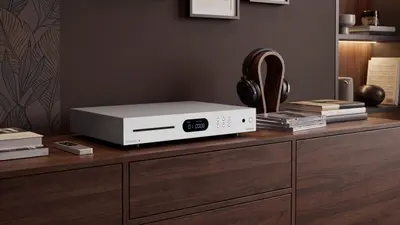
Audiolab has announced an upgrade to its entry-level CD transport, the 6000CDT, with the release of the 6000CDT MKII.
The company says that the 60000CDT MKII has been reworked around five key areas, including a brand new CD transport mechanism, revised servo architecture, a redesigned power-supply circuit, updated transformer implementation, and new master clock circuitry, which Audiolab claims “provide more consistent disc reading and a stable, clean S/PDIF digital output”.
While everybody is familiar with the good old fashioned CD player, some of you might not know so much about CD transports. The CD transport's main job is to read the data on the discs accurately, but it doesn't have a built-in DAC like integrated CD players do. Instead of outputting an analogue signal, CD transports output a digital signal which can be fed into an external DAC or the one already in your amplifier; an approach that grants users more control over the sound of their system.
Alongside standard ‘Red Book’ 16-bit/44.1kHz CDs, the new transport accepts CD-R and CD-RW discs. What’s more, it can also play data CDs containing FLAC, WAV, WMA, MP3 or APE files, with support for sample rates up to 96kHz for suitable file formats.
The 6000CDT MKII also features an OLED display screen and includes convenient features such as auto standby and a 12V trigger in/out for wider system automation. Outputs include optical and 75-ohm coaxial digital connections.
In terms of technical updates, Audiolab says that the “most fundamental” change from the previous model is a new slot-loading CD transport mechanism which improves physical stability, reduces operating noise and provides “faster, more assured disc handling”.
The servo control system has also been updated to improve the stability of data reading as the laser follows the CD's microscopic data track. Audiolab says that these changes allow the 6000CDT MKII to make more effective use of its error-correction process for discs in bad condition.
(Imag


Comments
No comments yet. Be the first to share your thoughts.