Oak Ridge labs gets hybrid quantum-HPC system to test qubit error correction
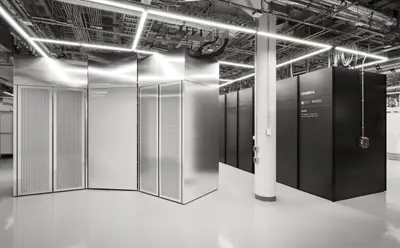
Oak Ridge National Laboratory (ORNL) now boasts a system for research into quantum error correction, combining IBM quantum processors with a high-performance compute (HPC) system based on AMD silicon.
The Quantum Science Center ( QSC ) at ORNL, funded by the US Department of Energy (DoE), unveiled what it calls a co-design platform for quantum error correction, marrying up quantum and HPC technology.
While useful, fault-tolerant quantum systems always seem to be at least a decade away, there have been notable advances over the past several years in the field of quantum error correction, according to ORNL. These include early demonstrations of protecting quantum information from environmental noise, which can cause loss of the fragile quantum states needed for computations.
"Solving the challenges of quantum error correction is essential to making quantum computing a practical tool for scientific discovery, which is a priority for Oak Ridge National Laboratory," said QSC director Travis Humble.
IBM Fellow and director of IBM Research Jay Gambetta said that it was no longer a question of whether error correction works, but how to accelerate and optimize error correction to build systems that scientists can use to tackle challenging problems.
"This new co-design platform for quantum error correction allows us to evaluate different approaches and determine the architectures, software and workflows that will scale," he stated.
ORNL's new tool combines an IBM Quantum System Two, equipped with the latest 120-qubit Nighthawk r2 quantum processors , and Umbra, a classical HPC system powered by AMD 5th Gen Epyc CPUs and Instinct MI355X GPU accelerators.
According to AMD, the CPUs provide the orchestration and general-purpose performance needed to coordinate everything, while the GPUs accelerate simulation, optimization and the parallel scientific computations surrounding quantum workloads.
Also part of the system are AMD Versal SoCs to provide the low-latency control, readout


Comments
No comments yet. Be the first to share your thoughts.