Check out the world's first 3D printed home in caravan form – and it's as eco-friendly as it is cute
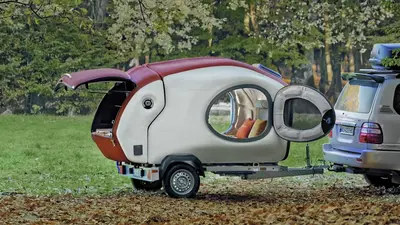
I've seen some pretty unusual approaches to camper design , but this one takes things to an entirely different level. Ukrainian-German company Lemki Robotix has developed what it describes as the world's first 3D-printed mobile home, creating a compact caravan using recycled plastic and specialist printing technology.
Called the Tiny Camper, the project demonstrates how 3D printing could change the way we build everything from camping equipment to mobile homes.
At first glance, the Tiny Camper looks like a rather futuristic take on the traditional teardrop caravan. Look a little closer, though, and you'll discover that its entire outer shell has been produced using large-scale 3D printing.
Developed by Lemki Robotix in collaboration with iScale3D, the camper uses recycled polypropylene reinforced with fibreglass. The material incorporates more than 7,000 recycled plastic bottles, while its nine-millimetre-thick walls provide strength without adding unnecessary weight. The result is a shell weighing just 250kg, making it relatively easy to transport.
The interior is designed to make the most of the available space, with a sleeping nook, kitchenette and plenty of storage. There's also an off-grid element, with integrated batteries that can be connected to solar panels, allowing the camper to generate and store its own power.
It gets cleverer still. Built-in sensors monitor things such as water levels, battery charge and temperature, giving the Tiny Camper some of the functionality you'd normally associate with a smart home. Not bad for something that starts life as a pile of recycled plastic granules.
The printing process itself is called Fused Granulate Fabrication (FGF), which uses plastic granules rather than the filament found in many conventional 3D printers. Lemki Robotix developed its own large-scale printing equipment, based on a robotic system from German manufacturer KUKA, alongside custom software to control the production process.
Beyond the novelty, ther


Comments
No comments yet. Be the first to share your thoughts.