How Isamu Noguchi's Akari lanterns became interior design’s favourite fixtures
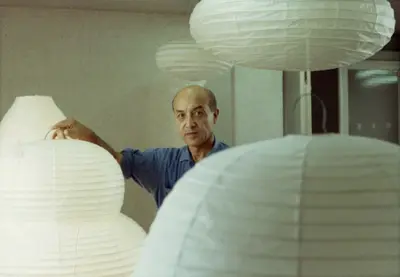
Isamu Noguchi ’s glowing washi lanterns and light sculptures have nearly become as universal as light itself. The paper lanterns glow far and wide, bringing a supremely soft warmth to homes, offices, hotels, restaurants and film and TV sets. The pioneering American artist and designer (1904–1988) created the first designs for his Akari light sculptures 75 years ago, a milestone that's now being celebrated with a new exhibition, now on view at his namesake museum in New York. From then on, Noguchi relentlessly formed new iterations. Despite spawning a legion of copycats and dupes, Noguchi’s original Akari shows no signs of dimming in appeal. Here's what to know about the Akari lantern's history and influence.
Isamu Noguchi photographed among Akari fixtures. (Image credit: Photo: Louise Dahl-Wolfe. © The Isamu Noguchi Foundation and Garden Museum, New York / Artists Rights Society) When did Isamu Noguchi create the Akari lantern?
Noguchi’s Akari light sculptures were born in 1951 during a visit to Gifu, Japan, where he encountered illuminated paper lanterns called chochin . The handcrafted lanterns made of mulberry bark paper were mostly used as decorations or advertisements, as Noguchi observed. Eventually, Noguchi was introduced to the city’s mayor, who requested that the artist revive Gifu’s lantern industry as it had become diluted by inferior replicas. Noguchi swiftly developed two ideas for lanterns with an eye toward the future:x he replaced the customary candle with an incandescent lightbulb.
Early Akari lantern designs in the 1950s. (Image credit: Photo: Stephen Michael. © The Isamu Noguchi Foundation and Garden Museum, New York / Artists Rights Society) What is an Akari lantern made of?
Under the term Akari, a Japanese word meaning ‘light’ that’s also associated with weightlessness, Noguchi established paper lanterns as sculptures that blend traditional craftsmanship with modern living. He fashioned Akari from high-quality materials used in Gifu: strips of

Comments
No comments yet. Be the first to share your thoughts.