arts at CERN translate the mechanics of the universe into creative installations
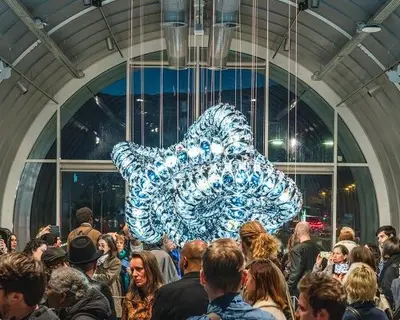
Arts at CERN and beyond
When asked, ‘What does CERN do?’ most people would probably scratch their heads and respond, ‘Physics.’ As the European Laboratory for Particle Physics in Geneva , it most certainly does physics, but another thing it does—alongside maintaining a Large Hadron Collider and developing inventions like the World Wide Web—is invite artists from around the world to produce work in tandem with the sciences. Through its artist residencies, commissions, and programs, it has invited the likes of Tomás Saraceno , Ryoji Ikeda , and other renowned artists to create works that, much like the laboratory’s research, demystify the world around us.
Artist GAIKA at the ATLAS Experiment at CERN | image by Sophia Bennett/CERN
Where art and science collide
There’s a feeling that the principles of physics, especially the discoveries made during the 20th century, have unlocked the mysteries of the universe. Films like Oppenheimer (2023) and Interstellar (2014) attempt to show the power of these principles through atomic bombs, time dilation, and wormholes. Yet, when sitting in front of an equation like e=mc², how many of us know what to make of it? When peering into the wires, buttons, and lights of a laboratory, what signals make it through to the brain? This is where the power of art comes into play at CERN —not only can it help transform these ideas into comprehensible forms, but it can also, at times, suggest new applications for these scientific tools.
artist Rohini Devasher at the International Centre for Theoretical Sciences in Bengaluru, India, as part of her Connect India dual residency | image by Harsh Khatwani/ICTS.
Visualizing the fourth dimension
Take, for example, Julius von Bismarck’s 2023 sculpture, Round About Four Dimensions. The artist, who apprenticed at the Berlin Institute for Spatial Experiments, created a ‘tesseract,’ or essentially a ‘shadow’ of a four-dimensional cube. When describing the project—a webbed, cube-like structure made of


Comments
No comments yet. Be the first to share your thoughts.