Royal Navy stands up first autonomous boat squadron
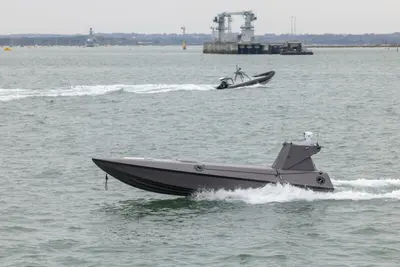
Britain’s Royal Navy has formally commissioned its first uncrewed boat squadron, operating seaborne drones on front-line operations as part of its “Hybrid Navy” strategy.
The force says the 1 st Autonomous Squadron officially entered active service on November 5 at a ceremony in Portsmouth Naval Base. It comprises around 180 personnel, about the same as a Type 23 frigate, split into two watches to enable operations around the clock.
This active squadron replaces Project Beehive, the navy’s experimental program to build a fleet of autonomous and remotely operated vessels, through which it obtained 20 uncrewed boats from UK-based Kraken Technology Group.
The force is understood to be using both Kraken’s K3 Scout, and the SM400 from SYOS Aerospace, known by the Royal Navy as the Rattler.
The K3 Scout is an 8.4 m boat capable of 55 knots and can carry a payload of up to 600 kg. It has a range of up to 650 nautical miles and endurance of up to 7 days. The maker describes it as capable of a range of missions, including anti-ship and anti-submarine to detecting and countering other drones and even casualty evacuation.
The Rattler boat is 7.2 m and has a 500 kg modular bay, with a range of up to 950 nautical miles. It was used last year in a demonstration during which 5 of the uncrewed boats were remotely-piloted to escort patrol ship HMS Tyne and mine countermeasures mothership HMS Stirling Castle
Part of the new squadron’s mission will be to act as pathfinder for drone operations, working on bringing additional types of uncrewed surface vessel (USVs) into fleet service and conducting a range of operations alongside other organizations – both as single vessels and as part of a task group.
The “Hybrid Navy” concept was outlined by First Sea Lord General Sir Gwyn Jenkins earlier this year, who made the case that uncrewed vessels would be vital in filling the gaps left by the Royal Navy’s much depleted surface fleet.
Speaking at the launch of the autonomous squadron, Fleet Co



Comments
No comments yet. Be the first to share your thoughts.