sprouted earth and soil spill across gallery for landscape of future memories installation
BURO ZEMLA Composes Landscape of Future Memories installation
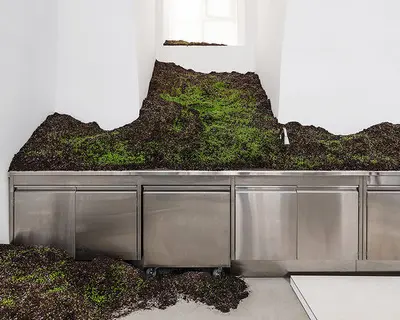
Conceived by landscape architecture and design practice Buro Zemla, Landscape of Future Memories is a site-specific installation presented within the A-House gallery space as part of the exhibition Architecture 1.0. The project examines the relationship between physical topography, spatial perception, and memory retention, framing architecture as a medium that shapes emotional and mental cartographies beyond physical permanence.
Landscape of Future Memories is an ephemeral installation by Buro Zemla | all images ©Buro Zemla
EPHEMERAL INTERIOR FRAMES THE MEMORY OF PHYSICAL SOIL AND EARTH
The installation by design practice Buro Zemla constructs an ephemeral interior landscape centered on the continuity of raw earth and soil. Operating on the premise that architectural programming often functions as an invisible sensory script, the design tests how an environment can leave residual traces in an occupant’s cognitive map long after the physical boundaries cease to exist. Through targeted spatial framing, layered materials, and communal sightlines, the project unites visitors around the memory of the soil, examining how shared spatial narratives can persist across time as collective mental landscapes.
the project investigates the intersection of mental memory and physical earth raw earth and mineral elements serve as the core tactile medium anchor of the installation detail view of the soil layers, illustrating granular textures and varying mineral tones daily photographic documentation tracked the progress of the installation different grass species were sown in a dark office space to identify the most resilient and undemanding varieties capable of germinating by the opening of the exhibition the test revealed which species germinated most successfully and how quickly they developed the same test was conducted in a naturally lit office space to compare the results installation of the structure using poly

Comments
No comments yet. Be the first to share your thoughts.