One of Germany's oldest knifemakers has looked to Japan for inspiration, and the result is a beautiful pocket knife that costs considerably less than you might expect
Germany has a long history of producing some of the world's finest knives, particularly in Solingen, where brands such as Böker have made cutting tools for generations.
However, the company's latest pocket knife takes inspiration from somewhere considerably further afield.
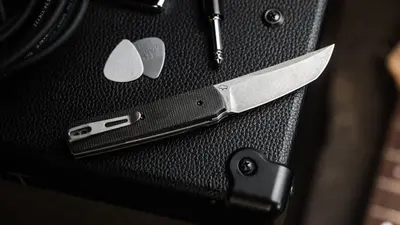
The new Böker Plus Mini Sanjo draws on Japan's centuries-old metalworking traditions, combining the distinctive appearance of Japanese blades with the practicality of a modern folding knife.
It's also a collaboration with French knifemaker Guy Poggetti, whose original Sanjo design debuted in 2024.
As its name suggests, the Mini Sanjo is a smaller version of that knife, though a few other changes make the new model particularly interesting for everyday carry enthusiasts.
A little piece of Japan
The Sanjo takes its name from a city in Japan's Niigata Prefecture, an area renowned for its metalworking and blade-making heritage.
Poggetti's design pays tribute to that history with a distinctive tanto-style blade, featuring an angular profile inspired by traditional Japanese knives and short swords.
(Image credit: Böker) The knife also blends Eastern and Western influences, with the clean lines of a gentleman's pocket knife contrasting with the blade's more purposeful appearance.
For the Mini Sanjo, Böker has reduced the blade length from 3.39 inches (86mm) to 3.07 inches (78mm), and the handle has also been updated, replacing the original brown burlap-style Micarta scales with textured black Micarta.
Combined with the stonewashed blade, the darker handle gives the knife a more contemporary appearance, although the slightly curved silhouette remains unmistakably Sanjo.
Smaller knife, different steel
The original Sanjo used Japanese VG-10 stainless steel, but the Mini switches to Swedish 14C28N.
It's a solid choice for everyday cutting tasks and offers good corrosion resistance and relatively straightforward sharpening.
(Image credit: Böker) The knife retains the original's front-flipper opening mechani



Comments
No comments yet. Be the first to share your thoughts.