marlot meyer’s giant inflatable creatures breathe with the tides of the wadden sea
a breathing ecosystem
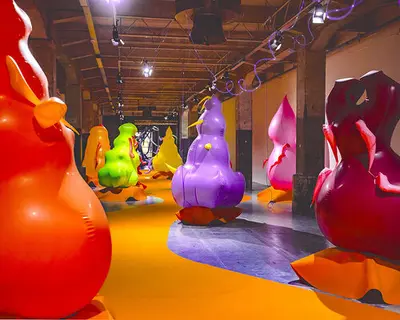
Inside an Amsterdam gallery, Dutch artist Marlot Meyer’s Pneuma (2025) brings together a curious population of giant inflatable creatures. Some tower above visitors, their brightly colored bodies swelling and shrinking as though they were breathing. Their movements follow the tides of the Wadden Sea along the Dutch coast, while visitors can influence the sculptures through their own breath.
The interactive installation connects two rhythms that operate on very different scales. This way, the movement of an entire coastal ecosystem becomes something people can experience through their own bodies.
Visitors are invited to embrace smaller inflatable beings fitted to the body with sensors that register their own breathing. These signals are translated into movements within the larger sculptures, creating a strange exchange between human respiration and the movements of the sea. The creatures appear to have lives of their own, responding to a distant environment while remaining sensitive to the people around them.
Marlot Meyer fills an Amsterdam gallery with ‘breathing’ inflatables | images © Sophie van Veen, Loods6
teaching the body to feel the sea
Before developing Pneuma, artist Marlot Meyer spent three months in Friesland, in the northern Netherlands, investigating whether humans could learn to physically sense the changing tides. During her residency at Het Lage Noorden, she placed wetness sensors in the mudflats near the Wadden Sea, which transmitted environmental data through radio signals to wearable devices. She called this research Project Tidal . Her aim was to introduce a new kind of sensory awareness, allowing the body to recognize the movement of water without having to see it.
Early experiments used small vibrating motors worn against the skin, with changes in the water translated into different vibrations. Meyer eventually began working with inflatable wearables, which she felt offered a more natural interpretation of the sea’s

Comments
No comments yet. Be the first to share your thoughts.