bacteria become the builders in ETH zurich’s exploration of living architecture
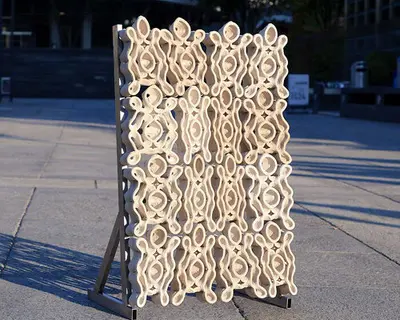
what if bacteria could build the architecture of the future?
At ETH Zurich , researcher Karen Antorveza Paez explores the possibility of bacteria becoming architectural collaborators by combining microorganisms , sand and digital manufacturing to produce solid building elements. Through a process known as biocementation, bacteria bind loose grains together with calcium carbonate, the mineral found in limestone, mussel shells, and chalk. By integrating this biological process with 3D printing and robotic fabrication, her research investigates how microorganisms can participate in shaping the built environment, challenging the idea of architecture as an exclusively human-made practice. The research introduces an alternative understanding of construction, one in which microorganisms actively participate in producing materials.
this facade element was created by bacteria | image by Kai-Hsun Yeh / ETH Zurich
when microorganisms become material makers
The process behind the research is called microbiologically induced calcite precipitation (MICP), also known as biocementation. It relies on bacteria called Sporosarcina pasteurii, which produce an enzyme that breaks down urea, triggering a reaction that generates calcium carbonate. The mineral that occurs, also found in limestone, mussel shells and chalk, forms microscopic crystals between grains of sand, binding them into a solid structure.
While biocementation has been investigated for years, particularly for stabilizing loose soil and developing self-healing concrete, Antorveza Paez approaches it as a material in its own right. Her research focuses on how biological processes can be controlled and integrated into digital manufacturing to produce architectural forms. The research gives bacteria an active role in the formation of the material. The architect establishes the conditions, develops the fabrication system and determines the geometry, while the microorganisms carry out the mineralization.
a robotic arm appl


Comments
No comments yet. Be the first to share your thoughts.