Astrophotographer captures stunning image of galactic witch playing with her crystal ball
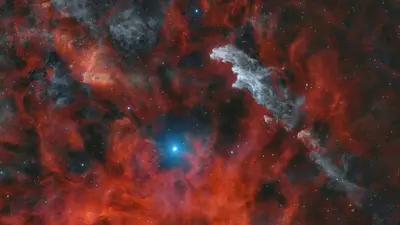
Did you know that roughly 800 light-years from Earth, out in the vast expanse of space, there is a witch who casts spells using her crystal ball?
I am, of course, talking about the Witch Head Nebula – officially cataloged by scientists as IC 2118 – a gigantic 50-light-year-long cloud of gas and dust located in the constellation Eridanus.
And her “crystal ball” is Rigel, a blue-white supergiant located in the neighboring constellation Orion. According to astronomers, the brilliant star is the seventh-brightest in the night sky, some 120,000 times brighter and 20 times more massive than the Sun.
The Witches Head Nebula which, supposedly, looks like a witch, extends from the middle-right to bottom-right of the image, 50 light years in reality, while the white-blue supergiant Rigel shines in the lower-centre part of the scene Piotr Czerksi Piotr Czerski is a Polish astrophotographer who, over the years, has had four images published by NASA's as its Astronomy Picture of the Day Piotr Czerksi Piotr Czerski’s gear and settings
Camera: ZWO ASI2600MC Pro
Lens: Samyang 135mm f/2.0 ED UMC
Exposures: LP filter: 62 × 300 seconds
Multiband filter: 12 × 300 seconds
Total integration time: 6 hours 10 minutes
“The blue reflection nebula is surrounded by a complex network of faint Hα emission (red visible light emitted by energized hydrogen atoms) and dark dust clouds, revealing subtle structures that are usually lost in shallower exposures,” Czerski explained in an Instagram post.
To capture the scene, the photographer used a ZWO ASI2600MC Pro camera and a Samyang 135mm f/2.0 ED UMC lens, taking 62 exposures with a light pollution filter and a further 12 using a multiband filter, each exposure lasting 300 seconds.
“It took six hours and ten minutes of total exposure time to capture all the faint details of the nebula,” said Czerski.
A post shared by Piotr Czerski (@piotr.czerski.photo)
A photo posted by
So brilliant was Czerski’s frame that NASA recently selected it as its Astron


Comments
No comments yet. Be the first to share your thoughts.