Sibling rivalry: we listen to both of Acoustic Energy's 40th-anniversary speakers to find out how they compare
Retro is very much the ‘in’ thing at the moment. The vinyl revival continues, and interest in cassette decks, reel-to-reel machines and even CD players has, if not boomed, grown beyond a gentle simmer.
Against this backdrop, it felt entirely logical that Acoustic Energy would want to celebrate its 40th anniversary with a very special ‘old’ product. Many companies would have taken that as an opportunity to launch a statement piece that shows off the full might of their engineering prowess, a ‘here’s what we can do’ design; Acoustic Energy chose a different route.
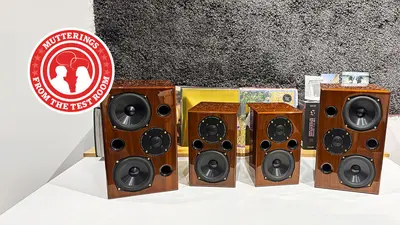
It released a reimagined version of its first speaker, the AE1, a tiny monitor that set new standards for performance, technology and price when it was introduced all those decades ago.
(Image credit: What Hi-Fi?) The AE1 40th Anniversary is entirely faithful to the ’80s original in its design principles and sonic priorities. However, it is engineered and manufactured to current standards.
The original tweeter and mid/bass have long been out of production, so Acoustic Energy’s engineers redesigned them from the ground up and tweaked the recipe a little.
The tweeter now uses a 29mm aluminium dome, 4mm larger than before, giving a greater radiating area, and the diaphragm is deliberately shallow to help increase bandwidth. The design is vented to keep the fundamental resonance low.
Like the original, this metal-dome tweeter uses ferrofluid to improve power handling and reduce dynamic compression. It crosses over to the mid/bass unit at an entirely conventional 2.8kHz.
The original mid/bass driver was an unusual design for the time. It has a rigid, straight-sided anodised-aluminium cone to promote pistonic motion, an unusually powerful motor system, and the ability to cope with high power levels thanks to good heat dissipation.
The new unit doesn’t change any of that, but the cone is now 5mm bigger at 12.5cm in diameter, increasing the radiating area and sensitivity. The engineers have also adopted modern prac

Comments
No comments yet. Be the first to share your thoughts.