The CAIM1 3D Printed Camera puts a security chip behind your photos as proof against AI deepfakes
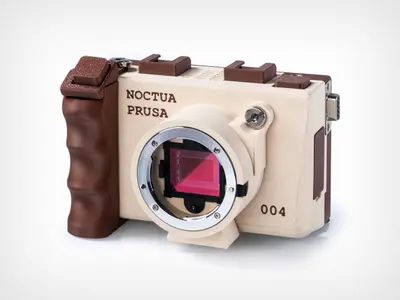
Every viral video now comes with a free side of doubt. You see a cat dancing to that Nicole Kidman song, or a deepfake meme of Jensen Huang with his Asian baddie girlfriend, and before you even laugh, your brain wonders whether the rest of the world can genuinely tell the difference between the real world and AI. Josh Cowell got tired of wondering. His startup, Caimera, built CAIM1, a prototype camera that cryptographically signs every photo and 4K clip the moment you hit record. The name stands for Counter Artificial Intelligence Machine 1, and its whole job is proving you were actually there.
It also looks like a chocolate bar that took up photography. The beige and brown shell is 3D printed in Prusament PETG using Noctua’s signature colors, a nod to the Austrian fan maker whose tiny 40mm NF-A4x10 keeps the internals from overheating. A Micro Four Thirds sensor sits behind a native Sony E-mount, and an auditable TROPIC01 security chip from Prague’s Tropic Square handles the signing. Want proof you can hold? CAIM1 can print a paper receipt for your verified footage, and the first batch is targeted for early 2027, with pricing still under wraps.
Designer: Josh Cowell (Caimera)
One Tiny Noctua Fan Keeps CAIM1 From Cooking Itself
Recording 4K at a targeted 60fps while generating cryptographic proofs on the fly pushes CAIM1’s processors hard, and passive heatsinks alone couldn’t keep up. Without active airflow, the chips would throttle and start dropping frames. The fix is a single Noctua NF-A4x10 5V PWM, roughly 1.6 x 1.6 x 0.4 inches (40 x 40 x 10mm), sitting directly behind the sensor on anti-vibration mounts. Air enters through front vents, crosses the sensor’s alloy backplate, passes through the fan, then sweeps over the CPU heatsinks before exiting the side. One fan handling both heat sources saves space, saves battery, and removes a second part that could rattle.
Picking the 5V version spared the team a step-up converter, which would have eaten board space,

Comments
No comments yet. Be the first to share your thoughts.