Nearly 20 years after launch, ancient AMD Radeon HD 2000 and 3000 GPUs finally get a Linux fix for corrupted video playback
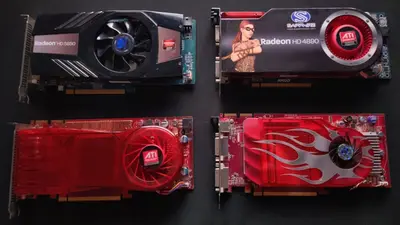
A newly accepted kernel patch slated for the upcoming Linux 7.5 release finally resolves a long-standing hardware video decoding bug on AMD's ancient R600 architecture, nearly two decades after the cards first hit store shelves. As spotted by Phoronix , the fix targets the Unified Video Decoder (UVD) engine across the RV610, RV620, RV630, RV635, and RV670 silicon families, making up the Radeon HD 2000 and HD 3000 families released starting in 2007. Linux users running these cards experienced visual corruption during hardware-accelerated video playback whenever the GPU was simultaneously handling active 3D or desktop drawing workloads; those issues should now be resolved.
I investigated video corruption on my older iMac7,1 (RV610/M74,device ID 1002:94c8). When the decoder was reading compressed video from system memory while the GPU was drawing, it would corrupt video frames. Moving the input to VRAM allowed frames to decode correctly. Disabling graphics draws also stopped the corruption.Here is a proposal to keep UVD buffers in VRAM for this family of devices, as the driver already does for some other chips. The patch covers RV610, RV620, RV630, RV635 and RV670. These chips share the RV6xx decoder path and legacy R600 firmware, so I think they are likely to have the same hardware requirements. Someone with the other hardware would need to verify that.I tested this on Debian. I used Codex to help with the investigation, testing and patch.
Ted Bullock, first-time kernel contributor
Interestingly, the breakthrough didn't come from a grizzled veteran of the open-source graphics stack, but from a newcomer utilizing OpenAI's Codex to help untangle the legacy driver path. The culprit turned out to be a memory placement oversight: the driver wasn't consistently keeping UVD input buffers pinned inside dedicated VRAM. When graphics draw calls competed for resources, frames failed to decode properly. By forcing those buffers to stay in VRAM — a behavior the Radeon kernel driv

Comments
No comments yet. Be the first to share your thoughts.