Google turned to AMD Epyc, not its own Axion chips, to secure its first confidential TPU
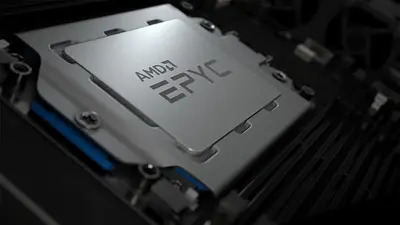
Google's new TPU 8tx pairs TPU 8t silicon with 5th Gen AMD Epyc "Turin" hosts to deliver confidential AI inference
The AI juggernaut passed over its own Axion CPU, which hosts the 8t and 8i, likely because its audited confidential stack is x86-only for now
The confidential TPU joins a growing number of chips even as key security details remain unpublished, even as Google and Nvidia already offer confidential GPUs to cloud customers
Google has added two more systems to its eighth-generation TPU family, and the one built for confidential AI leverages a host processor Google didn't design.
The TPU 8tx, detailed alongside the dual-chip TPU 8i Max in a Google Cloud blog post , pairs Google's accelerator silicon with 5th Gen AMD Epyc CPUs.
AMD also announced that Epyc forms the host foundation for what both companies call the first cloud TPU system with hardware-enforced confidential computing.
The same chip with a new trust boundary in tow?
Google's April 2026 launch split its eighth generation hardware into the TPU 8t for training and the TPU 8i for inference. Google bills this as the first time it has introduced four TPU systems in one year, but as ServeTheHome points out, the two newcomers are system configurations built on existing chips rather than new designs.
As per Taiwanese outlet INSIDE, the 8tx inherits the 8t's 12.6 petaflops of FP4 compute and 216GB of HBM, but swaps in the lower-latency Boardfly network used by the 8i. Google claims up to 2x lower latency than TPU 8t with a near-zero performance penalty, and pitches the system at regulated enterprises and governments that want to fine-tune, distill, and train agents on private data without moving it between clusters.
AMD says Epyc handles orchestration, data preparation, and the high-throughput link to the accelerators. Its Secure Encrypted Virtualization (SEV) works with the TPU to extend the protected environment out to the accelerators, checking each one's identity and security configuration before grant



Comments
No comments yet. Be the first to share your thoughts.