Modified Ender 3 becomes a $450 bioprinter for 3D printing engineered living materials
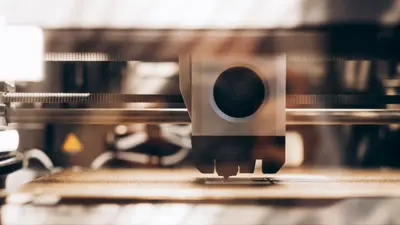
Microbiologists at the University of Rochester modified an Ender 3 FDM 3D printer into a 3D bioprinter for engineered living material (ELM) research. The team used SolidWorks to create the 3D model and sliced it in Slic3r, akin to a normal 3D printing workflow, with modified settings for the custom syringe pump print head. The $450 3D bioprinter makes ELM research more accessible, as bioprinters usually cost over $100,000.
Synthetic biology is like combining engineering with microbiology, treating microbes as machines and physical building blocks to achieve various functions. In the journal ACS Applied Polymer Materials, biologist Anne S. Meyer et al. published a 3 D Bioprinting of Engineered Living Materials paper in August. The paper says that synthetic biology and 3D bioprinting have advanced ELM research, but the hardware costs and the inability of the expensive hardware to maintain the structure limit further progress. Hitting two birds with one stone, the researchers built an open-source, affordable 3D bioprinter from an Ender 3 and created their own support slurry, allowing the ELMs to keep their shape.
The researchers kept most of the 3D printer's structure, mainly replacing the print head with a syringe pump mounted with custom 3D-printed PETG components, designed to utilize a 10 mL glass Luer-lock syringe with a plunger mechanism to control extrusion and retraction. The workflow is very similar to normal 3D printing, with the shape created with CAD using SolidWorks, exported as an STL, and sliced in Slic3r. The researchers tweaked the print settings in Slic3r to match the 0.254mm needle, with the extrusion multiplier dialed down all the way to 0.004, resulting in a flow rate of 2 mL/h at a print speed of 23 mm/s.
Instead of a filament, the researchers created a bio-ink from a mix of bacteria and alginate to be printed inside two types of support material: Agarose or gelatin gels. Agarose is used for long-term incubation, with the printed ELM staying viable

Comments
No comments yet. Be the first to share your thoughts.