neri oxman’s material ecology imagines a future where buildings grow like living organisms
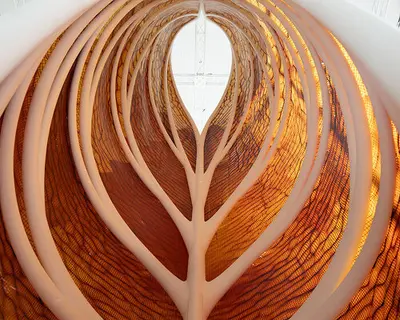
Neri Oxman’s vision for architecture shaped by nature
In her book Mediated Matter: Design and Invention in the New Biological Age, multidisciplinary designer Neri Oxman explores how biology , computation, and digital fabrication could reshape the way humans make and build. Drawing on two decades of research developed through her former practice, The Mediated Matter Group at the MIT Media Lab , the 612-page monograph introduces Material Ecology, an approach to design that positions nature as an active participant in the creation of materials , objects, and architecture.
The publication arrives at a moment when the consequences of human construction are difficult to ignore. Around 2020, the mass of human-made materials surpassed the total biomass of living organisms on Earth, according to research published in Nature. This imbalance brings into focus one of the central propositions of Oxman’s work, moving beyond the extraction and consumption of natural resources to explore ways of creating structures that actively contribute to the ecosystems they inhabit.
Aguahoja I, 2018 | image courtesy of Neri Oxman and The Mediated Matter Group
WHEN BIOLOGY BECOMES A DESIGN MEDIUM
The research behind Material Ecology took shape within The Mediated Matter Group, which Oxman founded and directed at the MIT Media Lab between 2010 and 2020. Working across architecture, engineering, synthetic biology, and digital fabrication, the group developed technologies that allowed biological processes and computational systems to operate together.
Among its best-known experiments is the Silk Pavilion, an architectural structure produced through the collaboration of robotic fabrication and 6,500 live silkworms. The project explored how their natural spinning behavior of the insects could participate in the construction of an architectural form. By controlling the distribution of fibers through light and heat, the researchers investigated how biological activity could complement robotic pr

Comments
No comments yet. Be the first to share your thoughts.