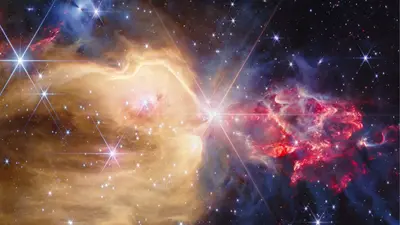
They say the birth of a baby is one of life’s most beautiful moments. What about the birth of a star, as captured in this James Webb Telescope photo?
The birth of a child: a pure, wholesome and, to some, angelic moment, unmatched by any of life’s other experiences. Now imagine this moment, only on an astronomical scale.
In the far reaches of space, approximately 3,300 light-years away, in the constellation Cepheus, lies a nebula categorized by astronomers as NGC 7129, but known by its more descriptive name, the Flower Bud Nebula.
Here, like a man and a woman coming together to produce a baby, cosmic dust and gravity frolic to create stars – sources of nuclear energy that, like babies, will bring new life to the universe, albeit for potentially billions of years to come.
NASA recently released this image of NGC 7129 , choosing it as the agency’s Astronomy Picture of the Day (APOD) for Monday, November 16 – the APOD, a long-running publication that kicked off in 1995.
Stars form when when gravity pulls together massive amounts of gas, but, according to NASA, things can get complicated when previously formed stars emit powerful jets and winds, with some then exploding. NASA has said that the red gas on the right side of the image appears to be a shooting jet (Image credit: NASA, ESA, CSA, STScI, JWST;Processing: A. Pagan (STScI)) According to NASA, many stars can be seen forming in the image, with the young stars on the left, immersed in the gold-colored gas, thought to be more mature than the young stars on the right, enveloped in the red gas, which appear to be shooting out jets of gas and dust.
While vibrant color helps us to better view this scene, the image was, in fact, captured using the infrared instruments aboard the James Webb Space Telescope (Webb), with color added in post-production.
NASA said that opaque dust can form in the cool atmospheres of stars and, when dispersed, can obstruct visible-light images. However, infrared light can pierce where visible light cannot, giving astronomers a deeper, more detailed look inside this cosmic birthplace and helping further our understanding of how stars are for



Comments
No comments yet. Be the first to share your thoughts.