Voyager 1 spacecraft crosses milestones distance of one-light day from Earth 49 years after launch
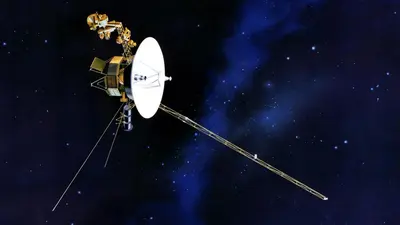
NASA has confirmed that Voyager 1 is the first human-made object to reach one light-day's distance from Earth, passing the milestone today. A countdown at Orbital Radar confirmed that Voyager cruised past the threshold at a leisurely 37,844 mph just after 5 am ET on Wednesday, November 18. It means that Voyager is now more than 16 billion miles away, and that a signal from the spacecraft now takes fully 24 hours to travel the distance.
There are many astronomical numbers behind what is an extraordinary feat. Sci-fi shows casually mention light-years as if they are like a trip to the local convenience store. One light-day isn’t a distance to be derided, though. Over the last half century, hurtling through space at a cruising speed of 38,000 mph, the Voyager spacecraft has clocked about 16 billion miles (about 26 billion kilometers).
These are probably bigger distances than you are used to fathoming. So NASA has kindly provided some context with the distances of various heavenly bodies in miles and light-speeds. For example, the Moon is 238,855 miles distant, or about 1.3 light seconds away from Earth. Due to Mars’ independent orbit around the Sun, it can take between three minutes and 22 minutes for light to travel between the red and the blue planet. Meanwhile, the Sun’s rays reach Earth, about 93 million miles away, in 20 light seconds. Now let us remind you that Voyager 1 is on the brink of being a whole light-day away.
On Wednesday, with this major milestone passed, Voyager 1’s journey will be far from over. NASA says that it is on course for an obscure star called Gliese 445, now in the constellation Ursa Minor. We’ll have to keep the champagne on ice for another 40,000 years to celebrate the fly-past of that star, though.
Voyager 1 carries a copy of the Golden Record . Like sending a message in a bottle, NASA scientists launched Voyager with the hope that someone, somewhere will eventually read the message. Moreover, the receiving aliens will need to source te


Comments
No comments yet. Be the first to share your thoughts.