We need something to move camera technology along. Could LOFIC sensors be the next step?
AI-enabled subject recognition to enhance accuracy, speed and performance, stacked sensors to boost low light sensitivity, plus global shutter architecture to enable ultra-fast, continuous burst shooting, are just some of the changes witnessed in camera tech in recent years.
But, with camera sales presently contracting and shipments slowing, I feel we need something more dramatic and significant when it comes to technological advancements to get us out of the current slump. Something to give photographers a reason to upgrade and get buying again.
In other words, we need a game changer.
I’m not talking about reinventing the wheel when it comes to photography. But, rather, seeking to uncover what might be enough of a step-up to get us all excited and enthused again.
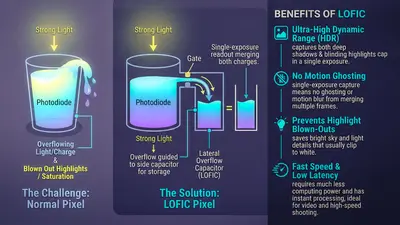
Could LOFIC sensors – an acronym of Lateral Overflow Integration Capacitor – be the answer? A recent post of mine here in which I suggested camera manufacturers are relying so much on past glories that they’re forgoing present and future innovation, solicited a comment to that effect. This prompted me to investigate industry rumours that consumer-level mirrorless cameras, including those presently embracing Micro Four Thirds, may receive LOFIC technology next year, or the one after – as we reported at Digital Camera World . The suggestion is that this will deliver the breakthrough of more than 17 stops of dynamic range, without the size of the sensor itself needing to be any bigger.
(Image credit: Google Gemini) This is possible with because each photodiode on a LOFIC sensor has an extra built-in capacitor next to it. And when a photodiode reaches its electron storage limit during a bright exposure, the excess charge – or lateral overflow – spills into the integrated capacitor, rather than clipping, or blowing out, the highlights.
Obviously, this would be godsend when faced with scenes that would otherwise prove challenging in terms of contrast. It would also let smaller sensor cameras potentially punch a



Comments
No comments yet. Be the first to share your thoughts.