willow defebaugh on the architecture of wonder and what nature teaches us about design
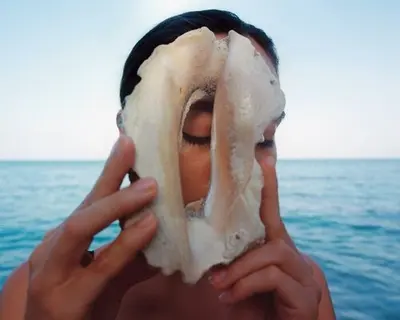
WE ARE MADE OF WONDER
The atoms that shiver throughout your being are older than organic life. The elements that bind you together were born in the earliest moments of the universe and forged in faraway stars. The sugars that permit your muscles to move were all made by plants devouring light from a fiery orb. The oxygen that fills your lungs is borrowed from forests and oceans, and the water that makes up most of your body once fell from the sky as drops of rain.
You are constructed of wonder, which is to say nature.
all images photographed by Jacques Brun for Atmos
THE MYTH OF SEPARATION
And yet, much of human existence on this planet has been separated from it. The very word we use to describe the sum totality of life is defined by the exclusion of our species. Nature is a learned way of seeing the world as everything that isn’t us. To other anything is the first step to allowing harm, paving the road for extraction and catastrophe. We have bowed out of belonging to the revelry of biological exuberance that is the Earth, and then wonder why we feel lonely.
We can trace the roots of this divide to the Scientific Revolution of 16th- and 17th-century Europe, in which anatomy mapped the body, microscopic life revealed itself, the heavens no longer revolved around us, and gravity was demystified. Alongside these revelations, a new view took shape: nature as a series of mechanical processes, governed by laws that could be observed, understood, and harnessed. And humans, with our uniquely rational minds, were set apart.
THE CARTESIAN DIVIDE
Few did more to articulate this perspective than René Descartes. In Discourse on the Method (1637), he described the bodies of animals as machines. He believed that scientific knowledge could allow humans to become “the lords and possessors of nature.” Cartesian dualism was a fissure that cleaved the world in two: mind and matter, thinking subject and physical object. In order to understand the rest of life, we had to observe



Comments
No comments yet. Be the first to share your thoughts.