inside ava roth’s artistic collaboration with thousands of tiny bee workers
Ava Roth and the art of Kintsu-Bee
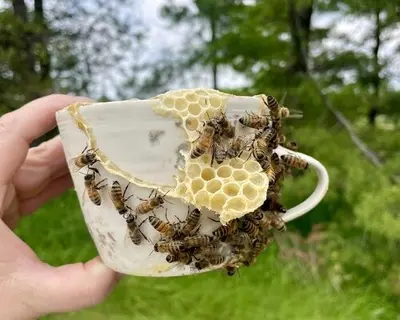
One of Ava Roth’s most valuable collaborators is not human. In fact, it’s the bees. In her series, Kintsu-Bee, she places broken ceramics into a hive of bees who, through the formation of honeycombs, create a new bond between the cracked pieces. The method is named after the Japanese repair method, kintsugi, which uses lacquer and gold leaf to create a shining new seam in broken dishware, turning what was once considered waste into a valuable new form. From this, Roth’s work expands beyond cups and plates. She has experimented with frames, textiles , and even embroidery hoops to create structures in collaboration with the planet’s busiest insects . In this extraordinary interspecies project, the Canadian artist and artisan creates a powerful meditation on the power of the natural world, craft, and more-than-human intelligence. Her work has gone on to be recognized by Homo Faber and has been exhibited internationally, including in Canada, where she’s from.
In conversation with designboom, artist Ava Roth shares what brought her to the hives, her multimedia works, and her relationship with the bees. She says of her process, ‘I am committed to sharing the labor equally, meaning that in each piece I try to give as much of my own time and effort as I am hoping the bees will offer.’
Kintsugi/Kintsu-Bee Cup #1 ceramic plate by Satoshi Yoshikawa and natural honeycomb | all images courtesy of Ava Roth Cherry Beach Salvage on Paper Salvaged garbage, rocks, encaustic medium, paper, wire and natural honeycomb
Busy bees and interspecies art
Famed American poet Emily Dickinson wrote in To make a prairie (1779), one of her poems about bees, ‘To make a prairie it takes a clover and one bee,/ One clover, and a bee./ And revery.’ In this musing on the creation of plains, the wonder bees can inspire comes to life. From their essential role as a pollinator species to their intricate hexagonal combs and the sweet honey they produce, bees are not o


Comments
No comments yet. Be the first to share your thoughts.