Nvidia finally reveals new Rubin GPU with almost 3X more CUDA cores than the Nvidia RTX 5090 — but you will have to wait till 2028 to grab it
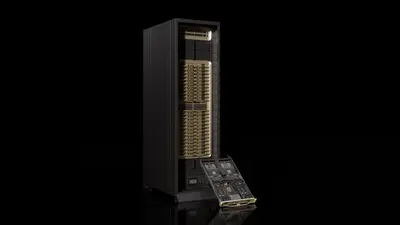
Nvidia's new Rubin HPC contains more than 50,000 CUDA cores
Its core count exceeds the RTX 5090's 21,760 by over 28,240
Nvidia expects Rubin HPC to reach deployed systems sometime in 2028
Nvidia has unveiled a new processor for scientific computing, with more than 50,000 CUDA cores contained within one graphics processing unit.
The Rubin HPC accelerator is intended for demanding simulations and data analysis, rather than consumer gaming or conventional desktop graphics applications.
Its core count exceeds the GeForce RTX 5090’s 21,760 CUDA cores by almost three times.
Over 50,000 CUDA cores with availability scheduled for 2028
Announced at the SC26 supercomputing conference, Rubin HPC will join Nvidia’s Vera Rubin platform as a specialized accelerator for technical workloads.
Nvidia says the chip will help researchers run simulations examining materials, molecules, industrial designs, climate systems, and other complex scientific processes.
The company expects the GPU to become available in 2028, leaving organizations several years before they can evaluate its performance in deployed systems.
The chip design combines numerous processing cores with faster data movement between computing components.
Nvidia says this balance should prevent processing units from remaining idle while waiting for information, a problem affecting data-intensive scientific calculations.
Rubin HPC also incorporates sparse data acceleration, intended to improve operations that retrieve limited information from much larger datasets during calculations.
According to the company’s technical description , these operations occur in applications involving sparse matrices, stencil calculations, sorting, and reduction tasks.
Such calculations recur across simulation, analytics, and engineering software, where the time required to access information can influence completion speeds.
The accelerator also adopts seventh-generation Nvidia NVLink technology, which is designed to improve communication betwe



Comments
No comments yet. Be the first to share your thoughts.