Same light, same result: iPhone 18 Pro’s sensor isn’t outplaying larger ones
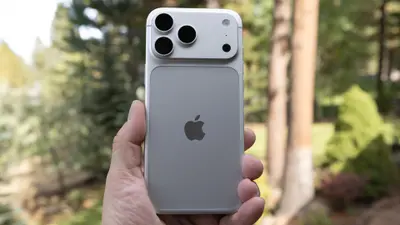
We shot the iPhone 18 Pro against a larger-sensor camera at equivalent settings to see whether the latest sensor developments allow smartphones to outperform larger sensors. It turns out the differences are in Apple’s processing.
Dale Baskin
With the release of the iPhone 18 Pro earlier this year, Apple introduced Pro controls, which let users manually set aperture, shutter speed and white balance inside the iPhone’s Camera app, without turning to a third-party app. (ISO remains automatic.)
A few weeks ago, we published our finding that using Pro controls to manually set the shutter speed comes with a trade-off. It bypasses an important part of Apple’s computational photography pipeline: the system that stacks multiple frames to produce higher-quality, lower-noise photos.
Manually setting the shutter speed in the iPhone 18 Pro’s Camera app bypasses the frame-stacking process that iPhones use to produce higher-quality, lower-noise photos. This makes sense: If the intent is to give users true manual control over exposure time, blending in frames captured outside that exposure time would undermine that control. Dale Baskin
As we explained in that article, there’s a defensible logic to that approach. If the intent is to give users true manual control over exposure time, blending in frames captured outside that exposure time would undermine that control.
However, it got us thinking. With frame stacking out of the picture, could we compare a photo shot on the iPhone 18 Pro to one shot with a camera with a larger sensor and see how it performs relative to what equivalence would lead us to expect? This would tell us whether the iPhone’s sensor is in a different league or if it performs about the way its size would predict.
The setup
We compared the iPhone to a Micro Four Thirds camera, the OM System OM-1. We chose Micro Four Thirds largely because it shares the iPhone’s 4:3 aspect ratio, which let us closely match framing between the two cameras.
The OM-1’s Four Th

Comments
No comments yet. Be the first to share your thoughts.