Grainy police video stills, empty chairs and faces in the dark: Robin Dahlberg's photos show how the claustrophobia of the interrogation room pushes innocent people into confessing
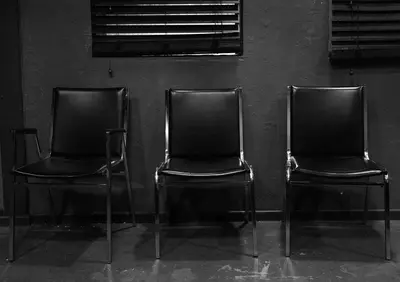
Why would anyone confess to a crime they didn't commit? Robin Dahlberg has come up with an answer that all of us can instinctively understand – and it's now available in the form of a photobook.
According to the National Registry of Exonerations, between 1989 and 2024, 13% of all people wrongly jailed in the US had been convicted due to a false confession. Dahlberg knows the subject better than most.
Before becoming a photographer, whose work is held in the collections of the Museum of Modern Art and the New York Public Library, she trained as an attorney and spent two decades in the national legal department of the American Civil Liberties Union.
Her book, Breaking Point: When the Criminal Justice System Fails , published by Kehrer Verlag , brings those two worlds together.
Created in collaboration with six exonerees, the book uses photography to explore how coercive interrogations can push innocent people to admit to crimes they had nothing to do with… and invites the reader to step into the interrogation room alongside them.
It features testimony from Jeffrey Deskovic, Vanessa Gathers, Byron Halsey, Eddie Lowery, Christopher Ochoa and Raymond Santana. Each was subjected to a coercive police interrogation, each confessed and each spent years in jail before being exonerated.
From the book Breaking Point: When the Criminal Justice System Fails (Image credit: Robin Dahlberg / Kehrer Verlag)
Lorenzo Montoya. An altered still from a Denver Police Department video recording of the 2000 interrogation of 14-year-old Lorenzo Montoya, who falsely confessed to murder and spent 13 years in prison before being exonerated by DNA evidence (Image credit: Robin Dahlberg / Kehrer Verlag)
An altered still from a Fontana, California, Police Department video recording of the 2018 interrogation of 53-year-old Tom Perez (Image credit: Robin Dahlberg / Kehrer Verlag) Deskovic, a 16-year-old high school student in Peekskill, New York, was told he'd failed three bogus polygraph tests an
Comments
No comments yet. Be the first to share your thoughts.