Monster Truck or Killdozer: Researchers used Machine Learning to teach a 12,000-lbs John Deere skid-steer loader to do 'complex acrobatic manoeuvres' i.e., street dancing
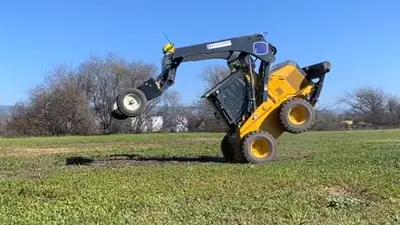
A John Deere loader now balances on two wheels without an operator.
Researchers trained the construction machine in simulation before real-world demonstrations.
The loader can spin while maintaining balance on uneven terrain.
A 12,000-pound John Deere construction loader has learned to perform movements normally associated with stunt driving, using artificial intelligence rather than human operators.
Researchers affiliated with ETH Zurich, Blue River Technology, Gravis Robotics and Intel used reinforcement learning and computer simulation to teach a John Deere skid-steer loader to perform autonomous acrobatic manoeuvres previously associated with highly skilled human operators.
They trained the machine to lift itself onto two wheels, maintain balance, navigate uneven surfaces, and execute controlled spins without assistance.
AI turns construction equipment into an autonomous stunt performer
The John Deere 332G skid-steer loader is an industrial machine designed primarily for moving materials and performing construction work.
Instead of relying on conventional programming, researchers developed an artificial intelligence system that learned suitable movements through repeated training and feedback.
The training process relied on reinforcement learning, a machine learning approach in which an artificial agent improves its decisions through rewards and penalties.
They first trained the control system inside a simulated environment before transferring its learned instructions to the physical construction machine.
This approach addressed several difficulties associated with automating heavy equipment, particularly machines controlled through complicated hydraulic mechanisms.
Hydraulic systems introduce nonlinear responses, fluid movements, flexible components, and operational delays that make precise automated control considerably more difficult.
The machine's considerable weight also makes physical experimentation dangerous, particularly when testing movements that requ



Comments
No comments yet. Be the first to share your thoughts.