This is one of your kitchen’s hardest working tools. Here’s how to keep it food safe
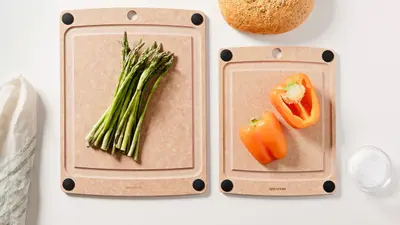
The cutting board might be the hardest working tool in the kitchen yet one thought about least. It takes the raw chicken, then the onions, then sometimes the bread, and in between it typically gets a quick swipe with the nearest sponge.
If cutting boards are given a second thought, it’s usually in the debate over whether to use wood or plastic. But the more important issue is how to clean and care for the boards you already own.
“I think the real question is not which is safer, but are they both safe to use?” said Donald Schaffner, a professor of food science at Rutgers University who studies how bacteria move between surfaces.
Knife fight! Plastic vs. wood boards
For a long time, plastic was considered the safer choice, mostly because it seemed easier to clean. Then in the 1990s, Dean Cliver, a food safety researcher at the University of Wisconsin-Madison, put salmonella and E. coli on wood boards and found the bacteria were pulled down into the wood, where they didn’t multiply and eventually died off.
Plastic boards were easy to clean, but once they were all scratched up, bacteria-harboring residue like chicken fat settled into the knife grooves and was hard to scrub out by hand.
Schaffner said the research is “a bit muddied,” but Cliver’s work showed “wood was not as risky as we thought.” Wood also has natural antimicrobial compounds that seem to help, at least somewhat.
Nicole Papantoniou, senior director of the Kitchen & Cooking Lab at the Good Housekeeping Institute, doesn’t pick a side. She uses both.
Beyond wood and plastic cutting boards
Papantoniou is a fan of composite boards, made from wood or paper fibers bonded with resin. They’re light and they hold up.
One paper composite board made by Epicurean was a winner of Good Housekeeping’s 2027 Kitchen Awards. Epicurean CEO Dave Benson said knife cuts in composite stay open instead of closing back over bits of food the way they can on plastic, which makes the boards easier to clean.
Schaffner point


Comments
No comments yet. Be the first to share your thoughts.