On this day in space! Nov. 24, 1947: The US Navy launches the 1st Aerobee sounding rocket, but it didn't reach space
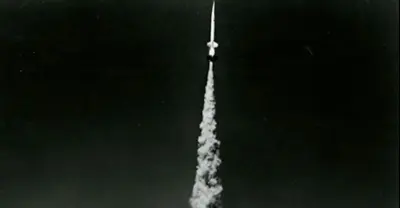
On Nov. 24, 1947, the U.S. Navy launched the first Aerobee rocket into the sky, but it never reached space.
Aerobee was a suborbital sounding rocket designed to study Earth's atmosphere .
After World War 2, the United States started reusing erman V-2 rockets for this kind of research. When they started running out of V-2 rockets , the United States constructed its own rockets that were similar but cheaper to build and to launch. In the weeks leading up to the first Aerobee mission, three test flights were launched.
Those tests used a dummy version of Aerobee with a live booster to see if the two stages would separate properly. On Aerobee's first real flight, the rocket flew about 35 miles high. That's below the 62-mile (100 kilometers) upper limit for the boundary of space . (NASA and the U.S. military typically consider 50 miles the edge of space.) Mission control cut the flight short after about 30 seconds, because Aerobee started to yaw, and they wanted to keep it from going completely out of control.
The first Aerobee sounding rocket launched on Nov. 24, 1947 under a project led by the U.S. Navy. (Image credit: U.S. Navy) Why it mattered
Billed as the " most successful sounding rocket of the space age ," the initial Aerobee rocket was suborbital rocket designed to launch experment payload of up to 100 pounds (45 kilograms) to an altitude of 75 miles (121 kilometers) or so.
"The Aerobee was designed to carry instruments aloft to collect data on the upper atmosphere and to place small animals in a weightless condition for physiological studies," the U.S. National Museum of the United States Air Force wrote in a mission overview . "It was launched by a solid-propellant booster engine of 18,000 pounds thrust that burned for only two and a half seconds."
An Aerobee suborbital sounding rocket of the type designed to study Earth's atmosphere. (Image credit: NMMSH) While the first Aerobee rocket did not reach space , many more made successful launches in the decades t



Comments
No comments yet. Be the first to share your thoughts.