SO–IL imagines a museum wrapped in shimmering glass scales in the norwegian forest
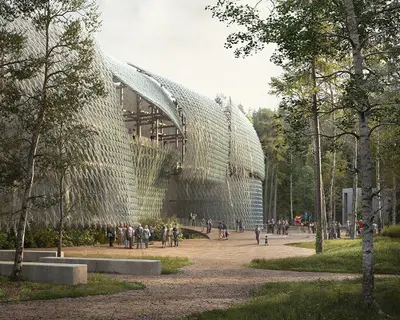
a new museum envisioned for Kistefos
Architecture studio SO–IL presents its design for the Kistefos Museum in Jevnaker, Norway , where an enveloping skin of translucent glass scales would take on the changing colors of the surrounding forest. The architects imagine a building with a swollen, almost organic silhouette that appears to float just above the forest floor. In the renderings, its pale green exterior takes on a silvery glow under the low Norwegian sun.
The proposal was developed as part of an international competition for a new museum at Kistefos, an art destination about an hour north of Oslo. The site occupies the grounds of a historic wood pulp mill and is already home to an extensive outdoor sculpture collection and BIG’s twisting, bridge-like gallery, completed in 2019.
The new museum was conceived as a permanent home for the collection of Norwegian art collector Christen Sveaas. SO–IL was among eight finalists in the competition, which ultimately saw Swiss architecture studio Christ & Gantenbein selected to develop the building in December 2025.
visualizations © SO–IL
an inhabitable facade of timber and glass
Much of the character of SO–IL’s architecture comes from its unusually deep facade. The architects call this space the ‘thicket,’ a timber-framed environment that occupies the perimeter of the museum. Custom glass elements are arranged in a repeating, scale-like pattern across its curved outer surface, with larger openings cut into the skin to expose the structure beneath.
From within the thicket, visitors would find themselves among a network of exposed wooden beams and elevated walkways. Metal staircases wind between floors, while platforms extend out toward the trees. There is enough room here for large sculptural works, some of which appear suspended within the timber framework.
The use of locally sourced wood recalls the industrial origins of Kistefos, where the production of wood pulp began in the late nineteenth century. Through th

Comments
No comments yet. Be the first to share your thoughts.