Oldest known quasar formed 630 million years after the big bang
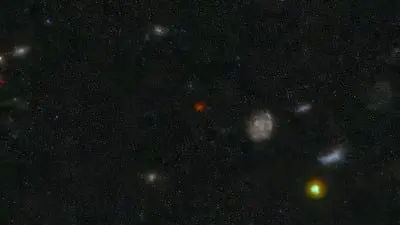
Andrew Paul, writing for Popular Science, reports that the European Space Agency’s Euclid space telescope has found the most distant quasar seen so far. The object is called J1504+6252, and it formed 630 million years after the big bang. That’s 40 million years earlier than the record Euclid set in July. The light in the image left it about 13.1 billion years ago, when the universe was five percent of its current age.
A quasar is a galaxy’s central supermassive black hole pulling in gas and dust while throwing off enormous amounts of energy. During that phase, the core can shine brighter than the rest of the galaxy.
J1504+6252 has a mass of about 360 million suns, and astronomers aren’t sure how it grew that large that early. It’s the first quasar found past a redshift of 8, a measure of how far light has stretched toward the infrared on its way here. Euclid has flagged 31 quasars in about 18 months of observing. Astronomers nicknamed this one Dún Aonghasa, after a prehistoric clifftop fort in Ireland.
See more at popsci.com .



Comments
No comments yet. Be the first to share your thoughts.