Rebels with a Cause. The inside story of how photojournalist Jean-Pierre Laffont shot US counterculture
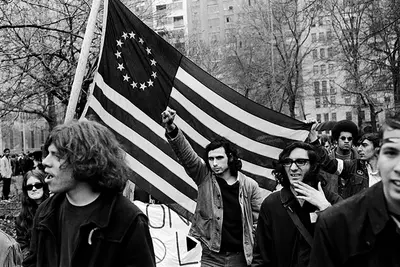
The French-American photographer Jean-Pierre Laffont dedicated a huge chunk of his working life, from the 1960s to 1980s, in order to shoot an outsider’s view of the counterculture of the US during a highly-charged period that was noted for its protests and cultural revolutions.
Laffont was born in Algeria in 1935 and he later attended high school and college in Morocco, from where he graduated in 1955. Four years later he achieved a master’s degree in Photography from the School of Arts et Metiers in Vevey, Switzerland.
A gesture of solidarity at the Attica funeral procession in Brooklyn, New York City, 25 September 1971. Photograph: © Jean-Pierre Laffont, courtesy of and published by Damiani Books
Following that, in 1960 he graduated from the Military Infantry Academy in Cherchell, Algeria, where he was a press officer. He then served in the French Army as a Commanding Officer based in the Oran region during the Algerian War throughout April 1962.
Between 1962 and 1964 Laffont was based in Paris, France, where he assisted the photographers Sam Levin and Choura, who were best known for their images of celebrities and movie stars.
2nd Gay Pride Parade, Manhattan, New York City, 28 June 1970. Photograph: © Jean-Pierre Laffont, courtesy of and published by Damiani Books
During this period of time Jean-Pierre Laffont began working in the fashion and portrait genres of photography and was hired by the movie maker Metro-Goldwyn-Mayer to shoot on film sets in Rome.
In 1965 he moved to the US and began a lengthy career as a photojournalist , initially as a staff photographer for Status Magazine.
Student protest in the Reflecting Pool in the aftermath of the Kent State shooting, Washington D.C., 9 May 1970. Photograph: © Jean-Pierre Laffont, courtesy of and published by Damiani Books
He would later become the first Foreign Correspondent for Gamma Press Images and, in 1970, opened Gamma’s new US office. During his time in the US he began documenting major historical

Comments
No comments yet. Be the first to share your thoughts.