European-Japanese BepiColombo mission becomes 2nd ever to arrive in orbit around Mercury
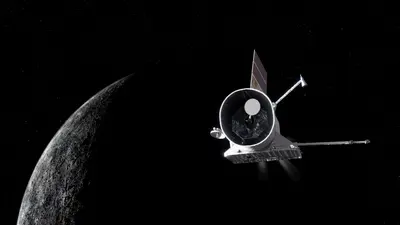
Update for 2:50 p.m. ET on Nov. 23: On Sunday afternoon (Nov. 22), the BepiColombo team announced that, while the spacecraft did successfully arrive in orbit around Mercury on Saturday (Nov. 21), the engine burn that got it there was cut short due to a software glitch. On Monday (Nov. 23), we got another update : BepiColombo "is safe and in a stable orbit around Mercury" and is on track for the next big milestone: The separation of its two orbiters on Dec. 9.
For just the second time ever, Mercury has received a robotic visitor from Earth.
The BepiColombo mission — a joint effort of the European Space Agency (ESA) and the Japanese Aerospace Exploration Agency ( JAXA ) — arrived in orbit around Mercury on Saturday (Nov. 21), more than eight years after leaving its home planet.
Before BepiColombo, just one spacecraft had ever circled the solar system's innermost planet: NASA's MESSENGER , which did so from March 2011 to April 2015.
BepiColombo consists of two main spacecraft: ESA's Mercury Planetary Orbiter (MPO) and JAXA's Mercury Magnetospheric Orbiter (MMO), also known as Mio.
The duo launched — along with a power and propulsion element called the Mercury Transfer Module (MTM) — aboard an Ariane 5 rocket from French Guiana in October 2018 , beginning a long and looping trip through the inner solar system.
Mercury is a difficult planet to reach because it's so close to the sun . Spacecraft approaching the planet are accelerated to high velocities by the immense gravitational pull of our star and must therefore shed a great deal of kinetic energy to be captured by Mercury's much weaker tug.
So the BepiColombo team designed a trajectory that featured one flyby of Earth , two of Venus and six of Mercury over the course of about seven years. That flight time was increased by a year , however, after the mission suffered an issue with its solar panels, which reduced the power available for the MTM's electric thrusters.
BepiColombo's arrival at Mercury will take a total o


Comments
No comments yet. Be the first to share your thoughts.