On this day in space! Nov. 20, 1998: Russia launches 1st module of International Space Station as construction begins on the largest human-built structure in orbit
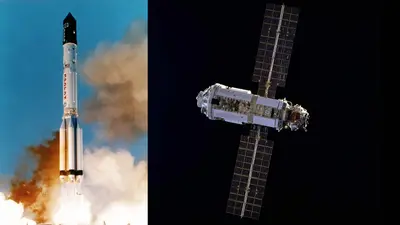
On Nov. 20, 1998, the first piece of the International Space Station launched into orbit.
The 42,000-pound module is called Zarya, and it's about the size of a tour bus. Zarya launched on board a Russian Proton rocket . Two weeks later, NASA's STS-88 shuttle mission aboard Endeavour brought the Unity module into space. The STS-88 astronauts connected the two modules in orbit.
Zarya was built by the Russians, but it was paid for by the United States. NASA contracted a Russian company to build it for half the price of what the American company Lockheed Martin would have charged. These days, Zarya is mainly used for storage and for external fuel tanks. The module also has docking ports for Russian Progress cargo ships and Soyuz spacecraft that carry crews to and from the space station.
Today, the I nternational Space Station is about the size of a football field and typically hosts up to seven crewmembers. But back in 1998, it was a pretty tight squeeze.
A Russian Proton rocket launches the core Zarya module of the International Space Station (left), which can be seen in orbit (right) during the first mission to the station in 1998. (Image credit: NASA/Roscosmos) Why it mattered
As of this writing, the International Space Station is 28 years old, and has seen steady rotating crews of astronauts since the year 2000 (for 26 years and counting). It is a marvel of space engineering, but every engineering marvel begins the same: with the first piece.
And that is what the Zarya module is: The foundation of the International Space Station.
Zarya, also known as the Functional Cargo Block (or Russian acronym FGB), is the core module of the space station around which every other module was attached. It weighed 42,600 pounds at launch and is just aver 41 feet long and 13.5 feet wide. Inside, it boasts a total habitable volume of 1,650 cubic feet.
The Zarya and Unity modules are connecting in orbit to build the International Space Station. NASA The Zarya and Unity modules are con



Comments
No comments yet. Be the first to share your thoughts.