There's an impostor hiding in the Hyades star cluster. Can you spot it?
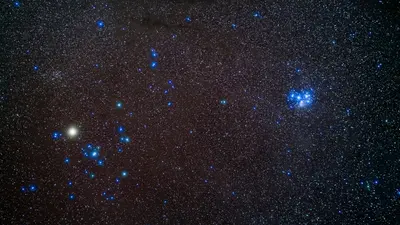
For years I looked at Taurus and saw something perfectly sensible. There was the Hyades, the big V-shaped cluster that forms the bull's face, with Aldebaran, noticeably brighter and more orange than the other stars, the dominant star. Every diagram reinforced the arrangement — Aldebaran was the eye of Taurus, the Hyades made the face, and in my head they became one object.
Then I discovered that Aldebaran has nothing to do with the Hyades. I remember going outside afterward and looking again, half expecting the deception to become obvious now that I knew. It didn't. Aldebaran still looked completely at home among the other stars . The difference is hidden in the one dimension our eyes judge poorly when we look into space — depth. Aldebaran is about 65 light-years away, while the Hyades are roughly 150 light-years distant. The orange eye of Taurus is a foreground star that happens to lie almost exactly along our line of sight toward the Hyades.
This fact exposes one of the most convincing tricks in stargazing. The night sky looks flat, and our brains are extremely willing to believe it. But it has incredible depth — and when you can see parts of the night sky in 3D, that's when you begin to appreciate that you're not looking at a flat map. Instead, you begin to see our cosmic neighborhood as it really is. By appreciating depth, you learn its geography.
What's happening and when to look
Aldebaran, the brightest star in the constellation of Taurus. (Image credit: Christophe Lehenaff via Getty Images) Taurus is now easy to find from the Northern Hemisphere during the evening. Once it's dark, look east for a small, tight knot of stars — the Pleiades open cluster (M45) — and then look nearby for a much larger V-shaped arrangement. That V is the Hyades, with unmistakably orange Aldebaran apparently sitting on one arm. Aldebaran's name is derived from the Arabic Al Dabarān, meaning "the follower," because it appears to trail the Pleiades across the night sky.
The Hyades is



Comments
No comments yet. Be the first to share your thoughts.