Mathematicians make a breakthrough in 174-year-old problem
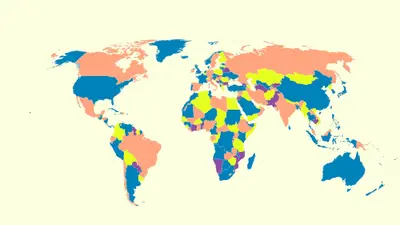
While mathematicians technically solved a nearly 175-year-old theorem known as the Four-Color Problem in 1976, the problem continues to vex researchers. For some in the field, their fascination with the perniciously complex concept runs so deep, that they liken their obsession to a lingering disease. But after a decade of analysis, an international team of mathematicians has made the first major breakthrough in the ongoing Four-Color Problem saga in 30 years. At this year’s Foundations of Computer Science (FOCS) conference, investigators laid out the optimal, most efficient algorithm that solves the Four-Color Problem.
What is the Four-Color Problem?
The underlying conceit to the Four-Color Problem is deceptively straightforward. In 1852, 19th century English mathematician Francis Guthrie posited that you only need a quartet of hues to fill every border-enclosed region on a map. Think all territories, regions, states, and nations filled in with only four colors. The first proof was introduced in 1879, and seemed solid for 11 years. That is, until Guthrie’s colleagues found an error in the calculations.
It took more than 85 years until a full proof arrived—a particularly notable moment, since it was also the first major theorem proven by a computer program. However, many in the mathematical community took issue with the digital discovery after having difficulty verifying it themselves.
A more accessible proof arrived in 1997, but even then, the algorithmic system became painfully slow as sample maps grew larger. A handful of mathematicians around the world have pondered new approaches to the problem ever since—including University of Copenhagen computer scientist Mikkel Thorup , who likens his interest to a “four-color disease.”
“I would guess that at least 1,000 mathematicians have caught the four-color disease, spending months trying to make it work but never quite succeeding,” Thorup said in a university profile . “It is the disease people have suffered from



Comments
No comments yet. Be the first to share your thoughts.