In the southwest of England, a photographer documents a local company harvesting spaghetti, but it's not the pasta you expect – and snorkels are needed
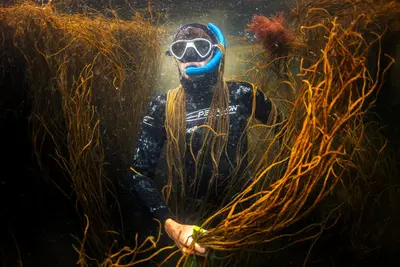
We've all eaten spaghetti Bolognese but, unlike the wheat-based pasta at the heart of that dish, did you know that there's another type of spaghetti? Only this spaghetti is brownish-green, slimy and grows underwater.
I'm talking about buttonweed. Otherwise known as sea spaghetti, buttonweed is an edible brown seaweed native to the North Atlantic – including the Cornish coast of southwest England, where documentary photographer Brad Wakefield captured a diver harvesting it for commercial products.
The frame recently won the “Documentary” category at the British Photography Awards (BPA) 2026, with Wakefield telling the BPA that in his shot, we see Dan Hawkes, a diver and harvest manager at the Cornish Seaweed Company, under the waves holding his freshly cut crop.
Brad Wakefield's gear
Camera : Canon EOS R6
Underwater housing: Ikelite
Lens: Tokina fisheye
“Seaweed is among the most nutrient-dense foods on Earth, naturally rich in iodine, iron, and essential minerals,” said Wakefield. In fact, according to the Food and Agriculture Organization (a United Nations agency), seaweed cultivation is one of the most environmentally friendly, and even regenerative, ways to produce food, too.
Unlike traditional land agriculture, seaweed requires no arable land, freshwater or pesticides to grow, and can even absorb excess nitrogen from agricultural runoff, which helps prevent toxic algal blooms and ocean dead zones.
But according to Wakefield, in the UK, seaweed cultivation is still a “widely overlooked” source of nutrition. Although marine biologists have also warned of the consequences of farming the algae on an industrial scale.
One of these consequences, scientists say , is light being blocked from reaching the seafloor. If this happens, then photosynthetic organisms native to the seabed, like seagrass and corals, cannot produce energy, triggering a domino effect that leads to their death and the collapse of the surrounding habitat.
A post shared by Brad Wakefield - Photograph


Comments
No comments yet. Be the first to share your thoughts.