Could a giant catapult launch someone to space? Short answer: Yes.
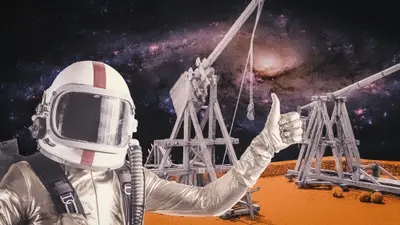
For as long as humans have looked at the night sky, we’ve wondered what lies beyond Earth—and dreamed up ways of getting up there. These days, powerful rockets carrying tons of fuel are the tried-and-true method of escaping the planet’s gravitational pull and reaching space.
But what if, instead of modern rockets, we went medieval? Could a trebuchet or catapult—the massive siege weapons once used to fling stones at castles—launch a person into orbit? And if so, just how big would one have to be?
The answer requires a little imagination, a lot of physics , and a space -launching siege weapon of truly ridiculous proportions.
What is a catapult?
A catapult is essentially a giant lever used to hurl projectiles. Typically, they have a large, spoon-shaped throwing arm that’s wrenched back, creating tension, and then released, flinging an object over a great distance.
Early catapults were used in ancient Greece and Rome more than 2,000 years ago. Image: Getty Images / Contributor / Universal History Archive
What is a trebuchet?
A trebuchet is a kind of catapult that uses a counterweight and gravity to launch projectiles. This machine’s long arm rests on a fulcrum, with a sling or cup for the projectile at one end and a heavy counterweight at the other.
When the arm is released, gravity pulls the counterweight downward, sending the opposite end—and its payload—soaring upward and forward.
Which is more powerful: a trebuchet or catapult?
Trebuchets are typically more powerful than catapults because they can launch heavier payloads over greater distances. So for our purposes, we’ll be focusing on a space trebuchet rather than a space catapult.
How old are trebuchets?
Trebuchets have been hurling heavy objects through the air for centuries. The structures are believed to have originated in China as early as the fifth century BC and eventually spread across Eurasia, becoming a formidable force in medieval warfare.
They arrived in Europe during the 12th century and q


Comments
No comments yet. Be the first to share your thoughts.