Chinese team boosts underwater drone sonar by over 10 dB with tungsten-silicone lens
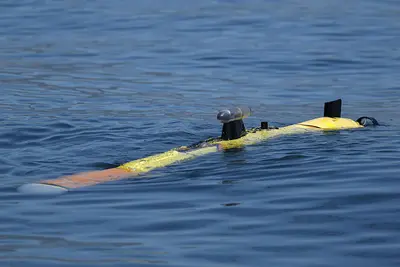
Researchers at Shanghai Jiao Tong University have developed a soft tungsten-silicone ‘contact lens’ which allows underwater drones to produce much sharper sonar images without any increase in power consumption and without the need for any complex signal processing.
The passive acoustic lens , developed by Professor Yu Zhang’s group, compensates for the distortions that the curved protective domes of underwater vehicles introduce, ensuring that the sonar beam remains well focused after it has passed through the dome.
“Every time an autonomous drone dives to explore the ocean floor, the very armor designed to protect it simultaneously blinds its sonar,” the researchers said in a statement, describing a long-standing engineering challenge for autonomous underwater vehicles.
Solving decades-old sonar problem
Underwater drones normally have their sonar systems contained within smooth, curved domes which serve to reduce drag and protect the delicate electronics. The downside, of course, is that the domes also bend and scatter the outgoing sound, which has a negative effect on sonar performance and makes it harder to pick up objects at a distance.
Engineers have traditionally tackled the problem with large phased array systems or complex software algorithms. Signal processing can only improve the quality of the received signal and cannot recover the acoustic energy that’s been lost through wave distortion. Larger electronic systems also draw more power, thereby reducing the operational time of battery-powered unmanned underwater vehicles (UUVs).
To overcome these limitations, Zhang’s team designed a passive acoustic lens that physically reshapes sonar waves before they leave the vehicle.
Using a technique known as time reversal, the researchers first worked out how the protective dome would distort outgoing sound. They then created a corrective lens by embedding microscale tungsten particles in a flexible silicone to create a material with acoustic properties very s



Comments
No comments yet. Be the first to share your thoughts.