a review of midcentury kinetic environments: when artists turned entire rooms into moving machines
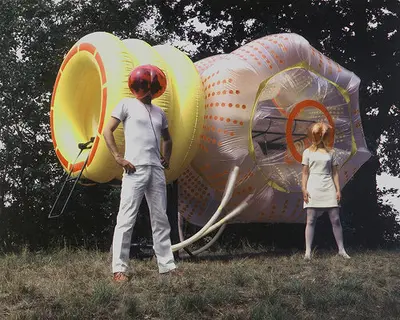
when motion became a property of space
Throughout the 1950s and 1960s, an international network of artists began to explore the possibilities of kinetic art at the scale of architecture. Motors and electrical circuits found their way into museum galleries, where entire interiors could be animated with moving structures and artificial light. In some cases, the machinery responded to the viewer’s presence.
An early precedent for these experiments came from the Bauhaus. In 1930, Hungarian artist László Moholy-Nagy introduced his Light Prop for an Electric Stage, also known as the Light-Space Modulator, at an exhibition in Paris. As the machine’s metal components rotated, light passed through perforated surfaces and bounced off reflective elements. Its movements generated a second composition across the surrounding walls. Here was a sculpture whose physical dimensions accounted for only a fraction of the space it occupied.
By the time Galerie Denise René staged its landmark exhibition Le Mouvement in Paris in 1955, movement had become the subject of a budding international art movement. Artists were experimenting with industrial technologies at a moment of renewed interest in the relationship between art and engineering. Over the following decade, some of the most ambitious projects in kinetic art would take the form of environments that visitors could physically enter.
László Moholy-Nagy, Light Prop for an Electric Stage (Light-Space Modulator) | video courtesy SFMOMA
from cybernetic sculptures to dynamic labyrinths
In 1961, a 52-meter steel tower by Franco-Hungarian artist Nicolas Schöffer rose beside the Palais des Congrès in Liège, Belgium. An arrangement of rotating reflective panels occupied its open framework, while an electronic control system coordinated its movements with light and sound. Schöffer also developed an animated light wall for the neighboring building. After dark, the project extended across the riverfront as reflections appeared on the surfa

Comments
No comments yet. Be the first to share your thoughts.