How Engineers Designed a Mission to One of Jupiter’s Icy Moons
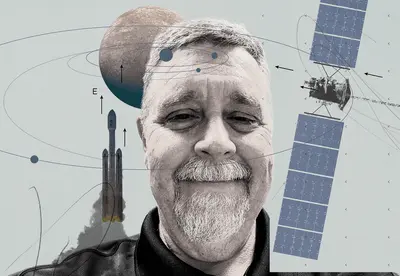
On 3 December 2026, a 30.5-meter-wide space probe will slingshot past Earth, picking up the speed it needs to reach Jupiter in 2030. The Europa Clipper is designed to investigate Jupiter’s enigmatic moon Europa and look for places that could support life in the ocean beneath the moon’s thick shell of ice. Tim Larson is the project manager for the mission at the Jet Propulsion Laboratory, and he spoke to IEEE Spectrum about designing and flying the Europa Clipper .
Tim Larson
Tim Larson is the project manager for NASA’s Europa Clipper mission. He has been at the Jet Propulsion Laboratory in Pasadena, Calif., for over 35 years.
Why take such a roundabout route to Jupiter?
Tim Larson: That’s all driven by the energy that we got from our launch vehicle, the Falcon Heavy . It set a MEGA trajectory: Mars-Earth Gravity Assist. So about 4 months after launch, we flew by Mars, got an assist there. Now we’re coming back in for a final assist from Earth to get on our outbound trajectory to Jupiter.
The Europa Clipper is set to orbit Jupiter and fly by Europa about 50 times to study it. Why not just orbit it directly?
Larson: The big challenge is the radiation environment. It is so intense that any spacecraft orbiting Europa wouldn’t last very long. So the mission designers came through with this concept of the flybys.
We will be in a three-week orbit around Jupiter, but the orbit is synchronized so that every time we fly by Jupiter, Europa is right there. Over time, you build up the coverage of the surface that we’re ultimately after. We spend a relatively short time in the high-radiation environment, and then the rest of the orbit is in a more benign environment where we can relay data back down to Earth, et cetera.
The Europa Clipper relies on solar panels to generate power. Why not use a compact radioisotope thermoelectric generator (RTG)?
Larson: It’s a national policy to only use RTGs if it is absolutely essential. A lot of the early concepts that focused on orbiting Eur



Comments
No comments yet. Be the first to share your thoughts.