Hair dye that turns your head into a brain-computer interface
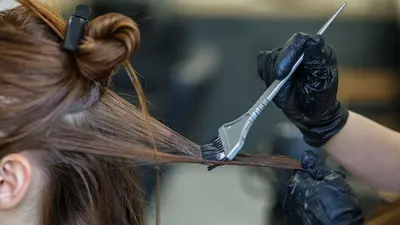
Researchers based at Ghent University in Belgium and Linköping University in Sweden have published a paper dubbed Electronic Hair: Transforming hair into a scalable bioelectronic interface . It is well known that skin and hair can get in the way of brain signal monitoring equipment, so sometimes hair is shaved and skin abrasively prepared for EEG readings. Furthermore, brain-computer interfaces are sometimes surgically embedded in a human's head for the best possible signal quality. But by treating hair with electronic conductive polymer dyes, scientists think we can create a better, stable, and natural interfacing platform. The idea has been dubbed eHAIR, for short.
eHAIR is claimed to transform hair "from a barrier into a functional bioelectronic interface." One approach that was tested uses highly conductive, low-impedance coatings that are readily applied and removed. Another bottom-up strategy grows conductive polymers directly on single hair strands. These complementary approaches yield stable, low-impedance, and highly conductive interfaces "that enable gel-free, comfortable EEG acquisition and direct compatibility with conventional hardware and human hair and skin," assert the researchers.
A: electrodes vs eHAIR (Image credit: Science Advances ) The nature of eHAIR creates potential applications beyond passive electrodes. Researchers highlighted that organic electrochemical transistors (OECTs) can be formed using individual hairs or hair bundles. So, the hair(s) can also act as transistor channels and could be used to amplify signals, for example.
Testing has shown that eHAIR facilitates improved signal amplitude, spectral power, and SNR compared to conventional gel-based electrodes. Medical professionals just have to reapply the coating or repeat the polymerization process if hair grows and degrades the electrical contact. This task isn't very complicated, with the scientists likening it to routine household hair coloring techniques.
At the end of their pa


Comments
No comments yet. Be the first to share your thoughts.