12 grains of dust found high in Earth's atmosphere reveal secrets of water at the edge of the solar system
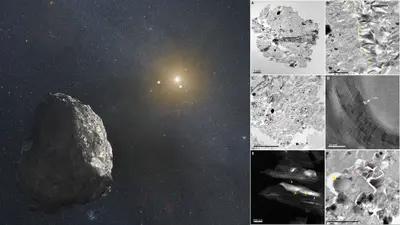
A dozen grains of dust that have wandered in from the distant Kuiper Belt beyond Neptune were found floating in Earth's stratosphere. And it turns out they hold the secrets of a special kind of 'heavy' water that seems to be surprisingly abundant in the outer solar system.
When analyzed by a team of scientists the 12 dust grains, which were captured by NASA's stratospheric ER-2 research aircraft, show signs of having interacted with a form of water that contains heavy oxygen isotopes.
This is important because to better understand how the planets formed, scientists are seeking to understand how various materials were distributed around the early solar system 4.5 billion years ago. If there is a reservoir of heavy water out in the solar system's hinterlands, understanding how that water got out there and stayed out there will inform models that describe the growth of the planets.
Water consists of two hydrogen atoms and an oxygen atom. What we usually refer to as heavy water is water that contains a heavy isotope of hydrogen. An isotope is an atom that contains the usual number of protons for that element, but a different number of neutrons . Elements are determined by the number of protons they contain. For example, hydrogen always has just one proton. Ordinary 'light' hydrogen has 1 proton and no neutrons, but its heavy isotopes – deuterium and tritium – contain 1 and 2 neutrons, respectively, in addition to the proton.
However, there's another kind of water that features heavy isotopes of oxygen instead. Ordinary 'light' oxygen is made from 8 protons and 8 neutrons and is hence known as oxygen-16 but some oxygen isotopes can have 9 or 10 neutrons, and we call these isotopes oxygen-17 or -18.
There have been a few clues that such a reservoir exists. Mineralogical evidence from a single carbonaceous chondritic meteorite and measurements from comet 67P/Churyumov–Gerasimenko indicated the presence of minerals that had formed from interactions between silicate rock and


Comments
No comments yet. Be the first to share your thoughts.