How does somebody born blind become a pro sports photographer? Meet Zak Skinner – a Paralympic athlete who also picks up the camera
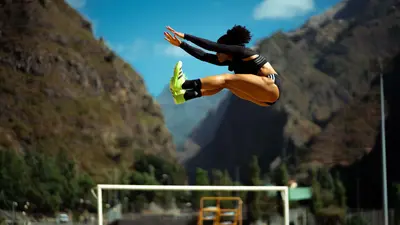
As a long jumper plummeted from midair, their silhouetted body stretched out against a seemingly blown-out sun, photographer Zak Skinner was ready and waiting to press the shutter, pointing his camera straight at the harsh source of light.
“We shot directly into the light, which I know people try to avoid,” explains Skinner of the frame, which was taken in Madeira, Portugal, for Sony's Through Their Lens campaign.
“I wanted all the sun flares. I wanted the reflections. I wanted the athlete in the foreground to kind of be like no detail.”
Taken at Centro Desportivo da Madeira, this image of a silhouetted long jumper in action with a blown-out sun to demonstrate Zak’s photophobia (Image credit: Zak Skinner) Okay, now you're going to pay me to take a photo, but you know I can't see”
Skinner , better known as a Paralympian who competes in the T13 100m sprint and long jump events for Great Britain, was born with ocular albinism – a condition in which his eyes never fully developed.
As a result, he has limited visual acuity and is unable to see fine detail. His condition also causes photophobia, an increased sensitivity to light.
“When there's bright light, it could be sunlight, it could be reflections or heavy lighting indoors, it means that everything will become almost silhouetted,” Skinner tells me. “So the idea of the [long jumper] photo was trying to portray that, but in an action-dynamic sporting shot.”
Zak Skinner is a British photographer and para-athlete who has represented Great Britain in the Tokyo 2020 (held in 2021) and Paris 2024 Paralympics (Image credit: Zak Skinner) While Skinner now has a level of vision, he only began to gain sight at the age of two.
So, how does somebody who was born blind, and who now sees with only a fraction of the clarity of someone without a visual impairment, become a professional photographer in an athletics niche where seeing split-second action can make or break your photos?
“The best way to learn is to get it wrong,” says

Comments
No comments yet. Be the first to share your thoughts.