Kioxia and Dell have managed to cram in a huge 157 PB of raw flash storage into a single 42U server rack
Dell fits 640 high-capacity SSDs into a standard 42U server rack
Kioxia's latest configuration delivers 157 PB across just 16 servers
The Dell installation occupies 32U, leaving 10U available for equipment
Kioxia and Dell Technologies have combined 640 high-capacity solid-state drives to achieve 157 PB of raw flash storage within one server rack.
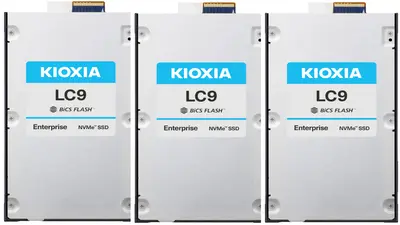
The configuration uses 16 Dell PowerEdge R7725xd servers, each equipped with 40 Kioxia LC9 Series SSDs rated at 245.76 TB.
The companies describe the installation as an industry-first achievement, although competing storage developers have reported configurations with even greater rack capacities.
640 SSDs deliver 157 PB of storage capacity
The installation runs Dell's ObjectScale software, an object-storage platform designed to manage enormous collections of unstructured information.
Its intended applications include artificial intelligence training, large-scale data analysis, and cloud services requiring substantial storage capacity.
Each PowerEdge server occupies 2U of rack space and accommodates 40 E3.L SSDs - and with 16 servers installed, the configuration consumes 32U of the standard 42U enclosure, leaving another 10U available for additional equipment.
The arrangement follows an earlier collaboration between the companies, which produced a configuration offering 9.8 PB of flash storage per server.
Multiplying that capacity across 16 machines produces approximately 157 PB, explaining how the latest installation reaches its advertised figure.
Kioxia's LC9 drives use eighth-generation BiCS FLASH technology, incorporating quad-level cell architecture and a 32-die stacking arrangement.
The drives also support PCIe 5.0 and NVMe 2.0, while their advertised mean time to failure reaches 2.5 million hours.
However, the maximum 245.76 TB capacity applies specifically to the E3.L version. The alternative 2.5-inch and E3.S models offer capacities reaching 122.88 TB, substantially reducing the available storage within an equivale



Comments
No comments yet. Be the first to share your thoughts.