MIT researchers use robotic motion to weave clothing directly around the human body
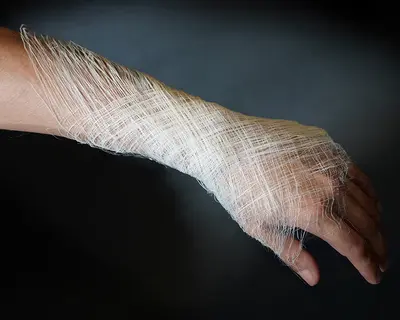
a new approach to garment-making begins with the body
Researchers at MIT Media Lab have developed a robotic fabrication system that weaves textiles directly around the human body . Called InSituWear, the experimental process uses an industrial robotic arm to draw fine plastic fibers around a person’s arm or hand, building a custom-fitting garment without conventional cutting or sewing.
Developed by the Critical Matter Group, led by Behnaz Farahi , the project explores a different approach to making clothing. Instead of beginning with a finished garment pattern, the researchers use robotic motion and material tension to determine how a textile takes shape around the body. The process brings fabrication and fitting together as the material forms directly on the wearer.
The team has demonstrated the method through a translucent sleeve and a color-changing glove. Both are made from networks of extremely fine fibers, whose arrangement depends on the movements of the robot and the physical contours beneath them.
images courtesy of Critical Matter Group, MIT Media Lab
robotic movement becomes the pattern
At the center of InSituWear is a process called melt-drawing, which uses polycaprolactone (PCL), a low-temperature thermoplastic. The robot pulls the heated material into fine strands, some as thin as 0.03 millimeters, and stretches them around the body. As the fibers cool, they solidify and retain their shape. The material is processed at relatively low temperatures, with the strands cooling to skin-safe levels before contact.
The robotic arm follows programmed paths around a simplified model of the wearer’s anatomy, with safety boundaries and collision checks built into the system. Interchangeable single-needle and multi-needle tools control how the fibers are drawn and positioned. The researchers can adjust the robot’s speed, the thickness of the strands, and the spacing between them to produce different textile structures.
Here, movement becomes an essential pa



Comments
No comments yet. Be the first to share your thoughts.