Voyager 1 is officially one light-day away from Earth
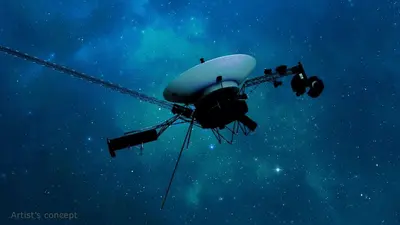
After traveling through space for almost 50 years, NASA’s Voyager 1 spacecraft should be one light-day away from Earth . The probe reached this record-breaking milestone at approximately 5:16:07 a.m. EST on Wednesday, November 18. Since takes about 24 hours to receive any signal from Voyager 1, NASA officially confirmed that it reached the distance on Thursday, November 19.
William Kurth , a research scientist at the University of Iowa who has worked on the Voyager mission since 1974 tells Popular Science that this mission is about more than just science.
“The Voyager missions represent humanity’s curiosity and hunger to understand our species’ place in the universe,” he says. “They show that we are explorers and can work together to do wonderful things.”
The Voyager spacecraft. Image: NASA/JPL-Caltech
What does one light-day away from Earth mean?
Astronomers often describe vast cosmic distances in light-years. It’s arguably the most famous unit of measurement when talking about the universe, in part because of its sheer incomprehensibility. A single particle of light travels at a speed of about 186,282 miles per second. Hypothetically speaking, if you fired a beam of light into the night sky at the outset of reading this story, it would travel around 44.7 million miles into space by the time you finished.
But even a unit like a light-minute isn’t particularly useful to astronomers. For them, cosmic measurements only start making sense on a scale of light-years. Voyager 1 is nowhere close to a light-year away from Earth, but a light-day (approximately 16,094,799,105 miles) is still basically impossible to envision as a distance. And since radio communications travel at nearly the speed of light, any messages to and from the spacecraft will require about 24 (Earth) hours to receive.
“Voyager 1 crossing the light-day threshold is yet another historic feat on an extraordinary voyage of discovery,” Dave Gallaghe r, the director of NASA’s Jet Propulsion Laboratory



Comments
No comments yet. Be the first to share your thoughts.