Supersonic jets want a comeback. But can Americans stand the boom?
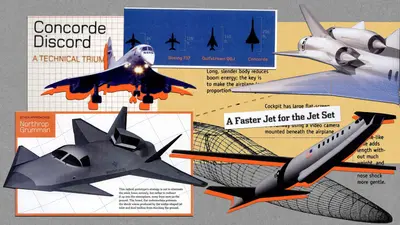
In the spring of 1967, William Shurcliff began moonlighting on a project that seemed hopeless: urging the U.S. government to stop supersonic jets. By day, the Harvard-trained physicist ran experiments at the Cambridge Electron Accelerator. By night, he spent hours writing letters—to congressmen, federal aviation officials, mayors, and newspaper editors. It was not a job he wanted. “I was hoping and praying someone else would do it,” he told The Harvard Crimson .
But no one else would. So Shurcliff launched the Citizens League Against the Sonic Boom and took aim at the most expensive project in U.S. commercial aviation history at the time, the Supersonic Transport (SST) program. His opposition to the SST stemmed from research by Swedish scientist Bo Lundberg, who had written extensively on the perils of supersonic aviation , chiefly the sonic boom, which could impact hundreds of millions of people every day. Shurcliff’s goal was uncompromising. “Just as the only way to get rid of the smell of the skunk is to eliminate the skunk,” he told The New York Times , “we propose to attack the sonic boom by eliminating the SST.”
It worked. In 1971, Congress cut off funding for the SST, and two years later the FAA banned civilian supersonic flight over U.S. soil.
Today, prompted by a 2025 executive order , the FAA is proposing to lift that ban before any community response tests of emerging supersonic technology have taken place. And even if new engineering designs can reduce the sonic booms at airliner scale, the economic and environmental costs that have plagued supersonic flight haven’t changed since Shurcliff’s day.
How a scientist from the Manhattan Project became an unlikely crusader against supersonic jets
During World War II, Shurcliff worked at the federal Office of Scientific Research and Development, helping keep the Manhattan Project’s atomic-bomb patents secret. In 1946, he witnessed firsthand the atomic tests at Bikini Atoll and wrote the official account, Bo


Comments
No comments yet. Be the first to share your thoughts.