Keeping It Real with LEDs
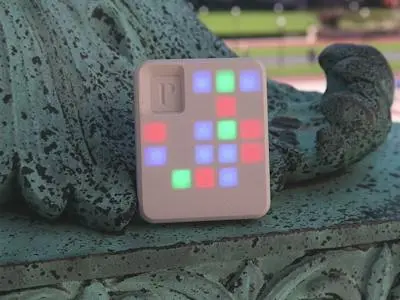
These days, it is hard to know when to believe your own eyes. Generative AI tools have gotten so good at producing realistic videos that even some of the telltale signs of a deepfake that we learned to look for just a year or two ago are no longer reliable indicators. But what if we could put something in front of the camera that AI would have a very difficult time reproducing? That is the idea behind a wearable electronic device called The Protector that was developed by a YouTuber known as The Information Syndicate.
The device was inspired by the security features that are built into paper currency to make counterfeiting difficult. The Information Syndicate wanted to develop something analogous to a watermark that could be applied to a person.
After some brainstorming, The Information Syndicate settled on the idea of building a collar lined with LEDs that would flash a series of patterns generated using public-key cryptography. After building several prototypes with 3D-printed frames and flexible LED strips, the creator headed to San Francisco to pitch the idea to investors. As it turns out, there is not much enthusiasm for wearing electronic collars, so it was back to the drawing board.
The electronics were ultimately miniaturized to fit inside a pin that can be attached to an article of clothing. With some help from a friend with electrical engineering experience, The Information Syndicate learned how to design a custom printed circuit board. The board contains a small computing module, a clock, a touch-sensitive control, and a grid of RGB LEDs. A custom enclosure was also designed to give the device a more polished appearance.
Each pin is assigned a unique private cryptographic key. Every second, the onboard processor uses the current time and that key to generate a new pattern on the LED matrix. With each of the 20 LEDs capable of displaying red, green, blue, or no light at all, there are more than a trillion possible patterns. Without access to the privat


Comments
No comments yet. Be the first to share your thoughts.