Could 4,400 square miles of Sahara solar power entire continents?
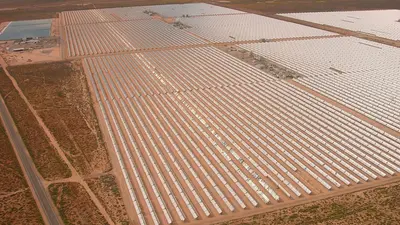
A terawatt of solar panels in the Sahara could generate more electricity in a year than Africa used in 2025. Even a project of that size, however, would supply no solar power after sunset, when households are still running lights, appliances, and air conditioners.
That gap between how much electricity a solar farm generates and when it can deliver it is central to the idea of powering continents from the desert. The Sahara has the sunlight to make a major contribution to grids in Africa and Europe.
Getting that electricity to consumers would take new power lines, storage, and agreements between the countries that produce, transmit, and buy it.
How much electricity could the Sahara generate?
Consider a hypothetical network of solar farms with a combined capacity of 1 terawatt. If each kilowatt of installed panels produced 1,800 kilowatt-hours a year, the farms would generate about 1,800 terawatt-hours annually before transmission and storage losses.
Africa used roughly 1,000 terawatt-hours in 2025, while the European Union used about 2,774. The same farms could therefore match Africa’s annual demand on paper or cover about two-thirds of the EU’s.
How much land would that take? Using the median land-use density of fixed-tilt solar farms in a US study , the panels and the space between their rows would occupy roughly 4,400 square miles.
The actual footprint would depend on the terrain and the farms’ layout. Developers would also need to find suitable sites near roads and power lines.
How would the electricity reach other countries?
Electricity already moves between Africa and Europe through two links connecting Morocco and Spain beneath the Strait of Gibraltar. Those links show that cross-continental power trade is possible.
A much larger export network would need power lines from inland solar farms to the coast, additional links across the Mediterranean and upgrades to the grids receiving the electricity.
High-voltage direct current can reduce losses on lon



Comments
No comments yet. Be the first to share your thoughts.